
Erath County Court Records After Jail Arrest
Court records after a jail arrest in Erath County are related to jail records, but they are not the same file. The jail record starts with booking into Erath County Jail and may show jail custody or bond data. The court record starts when the case moves into the court system through a complaint, information, indictment, or other filing. Prosecutor review can change the charge list after booking because jail charges are initial allegations, while court charges are formal case charges.
The official Erath County research identified Tyler PublicAccess as the main public-facing portal because the county's inmate-listing route opens a portal titled Court Records Inquiry with Jail Records and Jail Bond Records categories. Use Erath County jail inmate records for custody and booking details. Use Erath County jail mugshots for booking-photo questions. Use the court-record path for the formal case, charge status, bond orders, hearings, and disposition.
Find Court Records After Arrest
The confirmed public route is the Tyler PublicAccess portal. Static inspection saw the Court Records Inquiry title and jail-record categories, but did not expose full criminal case-search fields from the command line. If the portal does not reveal the needed case, contact the appropriate clerk office for older, sealed, non-indexed, or certified court records.
- Search the jail record first for name spelling, booking date, and any visible charge or bond entry.
- Open the Tyler PublicAccess portal and look for the court-record or jail-record category that matches the question.
- Search by defendant name, and use the booking date, case number, or charge when known to narrow results.
- Compare jail charges with court charges because the prosecutor may amend, reduce, reject, or replace the booking charge.
- Use clerk channels or a records request when the public portal does not show the formal case.
For statewide criminal-history context, Texas DPS operates the Conviction Name Search. That channel is not the Erath County docket and may involve fees or account terms.
Erath County Court Search Fields
The research confirmed only the public portal categories visible from the accessible page. Because the deeper search pages were not fully exposed, the table below avoids inventing field labels. It still shows what a reader can rely on before calling a clerk or the jail.
| Field or category | Type | Required | Notes |
|---|---|---|---|
| Court Records Inquiry | Portal title | n/a | Confirmed title on the Tyler default page. |
| Jail Records | Launched search link | n/a | Custody and booking search path identified as ID=400. |
| Jail Bond Records | Launched search link | n/a | Bond search path identified as ID=500. |
| Case, party, defendant fields | Unknown | Unknown | Not exposed during static inspection. |
Charges After an Erath County Arrest
After a jail arrest, the prosecutor reviews reports and decides what formal charges to file. The Erath County District Attorney page identifies the prosecutor's office and links a DA eDiscovery portal, but that eDiscovery link is not the same as a public jail roster. The formal court record may begin with one of several charging instruments.
| Document | Who uses it | What it does |
|---|---|---|
| Complaint | Law enforcement or prosecutor | Often starts the criminal process and supports arrest, magistration, or accusation. |
| Information | Prosecutor | A prosecutor-filed charging instrument used for many non-indictment cases. |
| Indictment | Grand jury | A grand-jury charging instrument used in many felony prosecutions. |
Charge Status in Court Records
Jail charges and court charges can diverge. A jail record can list the allegation at booking, while the formal court record can show a different charge level, a new charge, an amended charge, or a dismissal. Read each charge status by date and court action, not just by the first arrest label.
| Status | What it means |
|---|---|
| Pending | The charge is open and has not reached a final disposition. |
| Amended or reduced | The prosecutor or court changed the charge from an earlier version. |
| Dismissed | The charge was ended by court action or prosecutor action. |
| Deferred adjudication | A Texas disposition that may avoid a final conviction if conditions are completed. |
| Convicted | A plea or finding resulted in a conviction and sentence or penalty. |
Bond Records After Arrest
The Tyler portal exposes a separate Jail Bond Records route, which is useful after an Erath County arrest. A magistrate or court sets bond or release conditions after booking. A cash bond is paid directly. A surety bond is posted through a licensed bail bond company. A personal or PR bond is release on a promise to appear, often with conditions. A no-bond hold can keep a person in custody because of the charge, warrant, parole hold, another county, TDCJ, federal process, or immigration matter.
| Bond type | How it works |
|---|---|
| Cash bond | Money is paid directly to secure release and court appearance. |
| Surety bond | A licensed bail bond company posts surety, usually for a nonrefundable premium. |
| Personal or PR bond | Release is based on a promise to appear and may include conditions. |
| No-bond hold | Ordinary bond release is blocked by a court order, warrant, parole hold, or other authority. |
Warrants After Erath County Arrest
No official Erath County Sheriff active-warrant search page was located in the research. A warrant can still matter after arrest because it may create the booking or block release. TCJS categories for Erath County included bench-warrant and parole or blue-warrant categories in the population row. A bench warrant is issued by a court, often after failure to appear or a court-order issue. A blue warrant is a Texas parole warrant or hold. A fugitive or out-of-county hold can keep a person in custody for another jurisdiction.
If a warrant has already led to booking, check Tyler Jail Records and Jail Bond Records. For current custody and hold questions, call the jail. For the issuing court's warrant, court date, or compliance requirement, contact the court or clerk that issued it. People who believe they have an active warrant should get legal advice before appearing at a law-enforcement office.
Charges vs Convictions
A court record after a jail arrest may list a charge long before it lists a conviction. A charge is an accusation. A conviction requires a plea or finding that resolves the criminal accusation. Public records can show both, and casual readers often confuse them. The difference is central when reading a court record, DPS criminal-history result, or local jail record.
| Charge | Conviction | |
|---|---|---|
| Stage | Accusation after arrest or filing | Final result after plea or finding |
| Proof | Does not prove guilt | Shows a resolved guilty finding or plea |
| Where seen | Jail record, complaint, docket, information, indictment | Court disposition or criminal-history record |
Sealed and Expunged Records
Texas record limits can affect court records after a jail arrest. Expunction is governed by Texas Code of Criminal Procedure Chapter 55A and can erase qualifying arrest records. Non-disclosure can restrict some public access without treating the arrest as though it never existed. Juvenile justice information has separate confidentiality rules under Texas Family Code Chapter 58. Eligibility depends on the exact case history, so a docket entry alone is not enough to decide whether a record can be cleared.
| Sealed or non-disclosed | Expunged | |
|---|---|---|
| Public access | Limited public access to covered records. | Qualifying records are erased or treated as not existing. |
| Legal effect | Some agencies may still have access. | Access is much narrower after a valid order. |
| Common trigger | Some eligible dispositions. | Specific qualifying arrests or case outcomes under Chapter 55A. |
Erath County Prosecutor Review
The Erath County District Attorney page identifies the prosecutor's office at the Donald R. Jones Justice Center and lists District Attorney Alan Nash in the official staff directory. The prosecutor reviews law-enforcement reports and decides whether to file, amend, reduce, enhance, reject, or present charges to a grand jury. The DA page also notes security procedures for the justice center: the public enters through the main entrance at S. Graham and W. McNeill, passes through a metal detector, and bags or effects are searched.
The screenshot below comes from the official District Attorney page and is useful for routing court-record questions after a jail arrest.
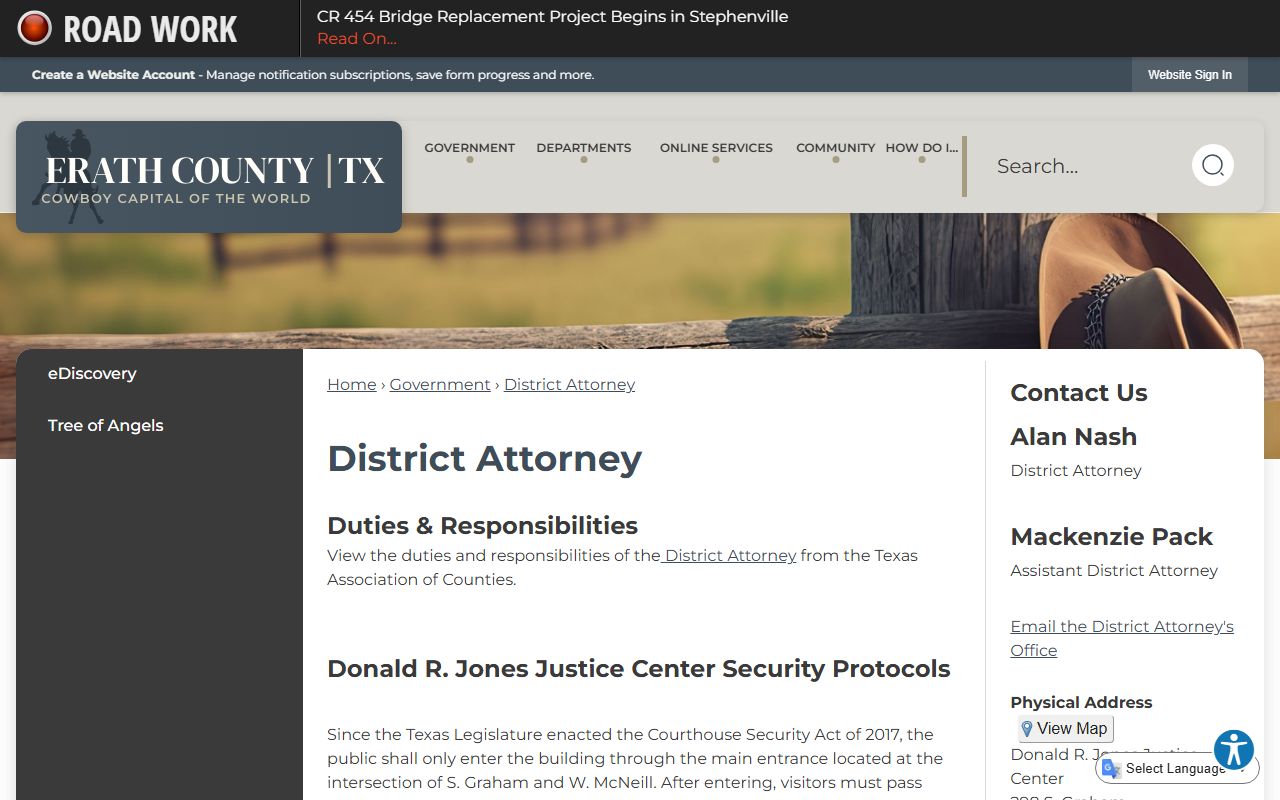
Use the prosecutor page for office routing, not as a substitute for the court docket, jail roster, or sheriff records request.
Arrest Reports and Public Records
Law-enforcement records tied to an arrest are requested through the Sheriff's Office, not certified through the court docket. The Erath County Sheriff NextRequest portal is the online channel for open-records requests. The sheriff's posted policy says basic public information is released within 10 days, costs are handled under the Attorney General model, and a request expected to exceed $40 receives a cost estimate under Texas Government Code Section 552.2615.
Important: A jail arrest is not a conviction, and public-record data must not be used for FCRA-covered decisions.
Restricted Court Records After Arrest
Some court records after an Erath County arrest may be unavailable or partly redacted. Active investigations, sealed records, expunction orders, juvenile records, protected victim or witness information, and records subject to a Texas Attorney General ruling can limit what the public sees. Texas Government Code Chapter 411 also governs criminal-history record information and DPS dissemination. Use the court or source agency for certified answers when a public portal result is incomplete.